

Sustainability and Off-grid Living
How is sustainability defined? It is the act of utilizing the resources necessary to sustain oneself while protecting the environment for future generations. Or simply living in harmony with nature.
What does it mean to live off grid? Off-grid living refers to a lifestyle where individuals or households operate independently from public utility systems, such as electricity, water, gas, or sewer services.
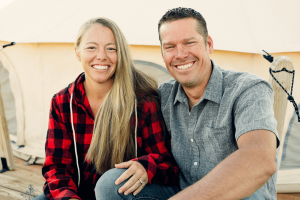
Keshia and I had always believed that our lifestyle and actions were environmentally conscious. However, upon reflection, we must acknowledge that living in an urban environment our entire lives often led us to prioritize convenience and comfort over environmental considerations — a common pitfall of city living. While we were never entirely uninformed, our efforts and awareness were somewhat naive.
When we launched Glamping Canyonlands with a sustainable business model, we expected the transition to be seamless. However, upon acquiring off-grid land to facilitate this goal, we realized that our sustainability footprint would undergo a more substantial enhancement than anticipated.
One of the initial and most profound realizations was that electricity is a comfort, not a necessity. While having power is certainly convenient, especially during extreme desert summers and winters, we survived without issue for a year and a half in a tent without power.
Two and a half years ago, I built a small office, which soon became our residence as well. This allowed us to install a solar system for personal power use. However, relying on off-grid solar is different from utilizing on-grid electricity, as it necessitates self-sufficiency. In our previous on-grid living situation, utility bills were more expenditure-driven than energy-focused. In contrast, our current off-grid living situation is limited by the capacity of our solar and battery system. As a result, our energy expenditures have decreased substantially compared to our urban ones. When purchasing electric devices now, we even consider watts and amps before, or equally to, manufacturing origin, cost and quality.
Another major realignment involved adapting to off-grid water access. Our off-grid water system involves transporting 425 gallons of water, weighing 3544 lbs, to an underground cistern. It’s a thirty-minute round trip per water load. A solar pump then brings the water above ground for on-demand use in our communal bathrooms and kitchen. Prior to adjusting to off-grid water systems, we exhibited less desirable water usage habits, including letting the garden hose run for extended periods and taking excessively long showers. Now, we are significantly more mindful of our water consumption. Every drop used upstream fails to arrive at the receding reservoirs downstream. The Colorado River Basin Watershed, which supports millions, is rapidly depleting. If individuals could experience off-grid water systems, I believe it would contribute to a partial resolution of the water problems in the SW.
In transitioning to an off-grid lifestyle, the most significant sustainable enhancements we implemented were related to electricity and water. However, we have also made several other environmentally conscious improvements.
As part of our pre-opening strategy in October 2020, we made a conscious decision to minimize our reliance on disposable paper products. To that end, we replaced paper towels with cotton hand towels in our bathrooms and cotton “paper towels” in our communal kitchen. By washing and reusing these items, we significantly decrease the volume of disposable paper products that would otherwise end up in landfills.
Despite the absence of a recycling program in San Juan County, we collect recyclables and haul them to Moab during our errands, which are an hour away.
In our commitment to sustainability, we have adopted the practice of raising our own chickens, a more eco-friendly alternative to buying eggs from a store. We currently have 18 chickens, which are fed a diet of 100% organic food, including organic sprouted wheat and barley.
Apart from our chicken-rearing activities, we have shifted towards a wholly organic diet, persistently endeavoring to discover and promote small, community-based regenerative farms whenever possible. Moreover, we operate a food waste composting program and furnish composting resources for our guests, encouraging their participation.
In an effort to minimize our environmental footprint, we actively seek out products with minimal or biodegradable packaging. We always bring our reusable bags when shopping and avoid buying single-use plastic bottled products. Our shopping habits include purchasing in bulk and selecting unpackaged items such as produce, grains, and spices, when possible. We also refill glass jars with things like freshly ground peanut butter from the local health food store. By adopting habits like this, we aim to reduce our contribution to the growing problem of plastic waste in our oceans.
Being off-grid and having plumbing necessitates the installation of a septic system, which is arguably the most sustainable method of managing human waste.
Whenever a new project emerges, we hold conversations about how to implement it in a more environmentally friendly way. For example, instead of trying to maintain a garden, which we discovered is not practical in most desert environments, we have started gathering old windows to build a greenhouse, which will eventually enable us to grow our own regenerative food. Additionally, we have recently come to an agreement that our next new construction project will utilize a sustainably fueled wood-burning stove for heating, rather than propane.
We have made considerable strides, but there will always be opportunities for further advancements. In my opinion, fully sustainable living within contemporary western society is nearly impossible. However, we are committed to doing our best, and I firmly believe that adopting an off-grid lifestyle will exponentially enhance anyone’s attempts at providing a better life for future generations.
So get out there, unplug, and enjoy!